

Identification
Roof Rat vs Norway Rat: Which One Is in Your Florida Home?
Florida has two structural rat species and they need two completely different jobs. Getting this wrong is the most common reason a rodent visit achieves nothing.


What is the difference between a roof rat and a Norway rat?
Roof rats climb and nest above ground, so they enter at the roofline and the work happens on a ladder. Norway rats burrow and live at ground level, so they enter at the stem wall, weep holes and thresholds and the work happens at grade. Roof rats are slimmer with a tail longer than the body and large ears. Norway rats are heavier and blunt nosed with a tail shorter than the body. Roof rats dominate residential Florida. Norway rats dominate ports, restaurants, farms and canal banks.
The Short Version
Where You Hear It Tells You Most of What You Need
Before anything technical, one question answers most cases. Is the noise above you or below and around you?
Overhead at night, in the ceiling or attic, along the same route each time: roof rats. Scuffling low in walls, under cabinets, around the foundation, or burrows you can see in the yard near the stem wall or a fence line: Norway rats. Near a port, a restaurant corridor, a marina, a canal bank or a farm, you may genuinely have both.
Roof Rat
Roof Rat (Rattus rattus): The Florida Default
Also called the palm rat, fruit rat, citrus rat and black rat. All five names describe the same animal, and the palm rat name comes from its habit of nesting in the dead frond skirt on palm trunks, known as the palm boot.
- Build: slim and agile, six to eight inches of body
- Tail: longer than the head and body combined, which is the single most reliable field mark
- Ears and eyes: large, prominent
- Nose: pointed
- Behaviour: an excellent climber that lives above ground in attics, palms, canopy and roof voids
- Enters at: soffit gaps, open tile ends at eave and hip, roof and gable vents, roof to wall transitions, and mechanical penetrations
- Found in: the overwhelming majority of Florida residential attic cases
Norway Rat
Norway Rat (Rattus norvegicus): Ground Level and Heavier
- Build: stocky and heavy, seven to ten inches of body
- Tail: shorter than the head and body, which is the quickest way to separate the two
- Ears and eyes: small relative to the head
- Nose: blunt
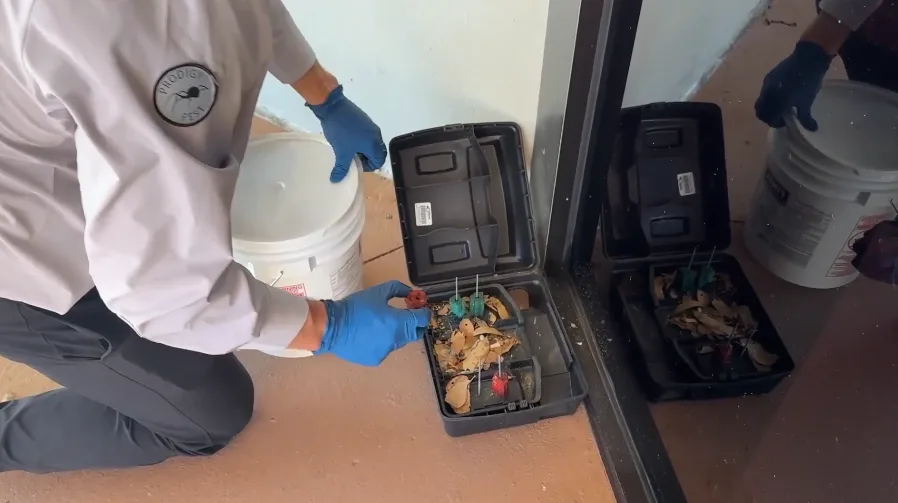
- Behaviour: a burrower that lives at or below grade, in banks, under slabs, around drains and beneath structures
- Enters at: the stem wall, weep holes, door thresholds, foundation and utility penetrations, and damaged drain lines
- Found around: ports and marinas, restaurant and dumpster corridors, packing houses, farms, canal banks and dike systems
Why It Matters
Why the Wrong Diagnosis Wastes the Whole Visit
The two species share almost no methodology. A roof rat job is a roofline job: survey from a ladder, seal soffit runs and tile closures in metal, set traps along overhead runways. A Norway rat job happens at grade: seal the stem wall, weep holes and thresholds, address drainage and burrows, use larger traps placed along ground level runs.
A company that seals your roofline beautifully while Norway rats continue entering at the stem wall has done careful work in the wrong place, and you will be calling somebody again in a month. Where you have both, which happens around ports, food corridors and agricultural property, the job needs both scopes rather than one.
Droppings
Telling Them Apart From Droppings Alone
- Roof rat: a quarter to half an inch, curved like a banana, pointed at both ends
- Norway rat: half to three quarters of an inch, thicker, blunt or rounded at the ends
- House mouse: an eighth to a quarter inch, thin, pointed, and far more numerous
Location matters as much as shape. Droppings on top of ductwork or in attic insulation are roof rat. Droppings along a foundation line, behind a dumpster or near a burrow entrance are Norway rat.
Not sure which one you have? We will identify it for free.
Questions
Frequently Asked Questions
Are palm rats and roof rats the same thing?
Yes. Roof rat, palm rat, fruit rat, citrus rat and black rat are five common names for Rattus rattus. They are called palm rats because they nest in the dead frond skirt on palm trunks, known as the palm boot.
Can I have both species at once?
Yes, and it is common near ports, restaurant and dumpster corridors, marinas, packing houses, farms and canal banks. In those settings a proper quote covers both the roofline and ground level rather than choosing one.
Which is more common in Florida homes?
Roof rats, by a wide margin, in residential attic cases. Norway rats dominate commercial, agricultural and waterfront settings, and appear residentially where there is wet ground level habitat with burrowing cover.
Does the treatment really differ that much?
Completely. Roof rat work happens on a ladder at the roofline. Norway rat work happens at grade with different trap sizing, heavier sealing at the stem wall, and attention to drainage and burrows. Quoting one when you have the other wastes the visit.
How do I check which I have without a professional?
Note where the noise is and look for burrows. Overhead at night is roof rats. Burrows near the foundation, along a fence line or by a service area is Norway rat. Droppings shape helps too: curved and pointed is roof rat, thicker and blunt is Norway rat.
Keep Reading
Related Guides and Services
- Rat Removal — both species, and what each job involves
- Mouse Control — smaller gaps, finer exclusion
- 7 Signs of Rats in Your Attic
- Commercial Rodent Control — where Norway rats dominate